


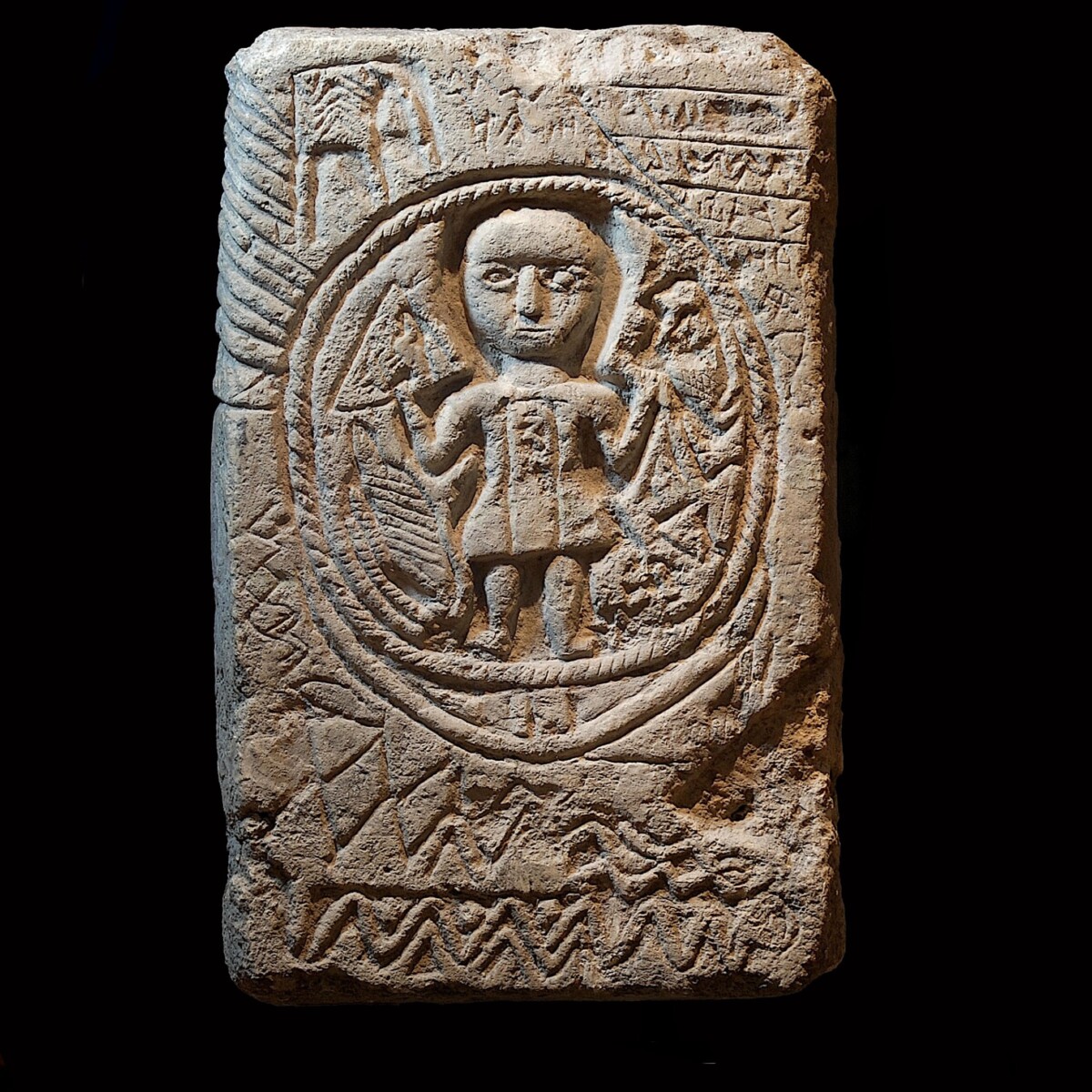
Coptic Limestone Funerary Stele Depicting a Boy in an Ouroboros
Culture: Egyptian
Period: 5th–7th century A.D.
Material: Limestone
Dimensions: 58.8 cm x 37 cm
Price: 24 000 Euro
Ref: 1557
Provenance: From the collection of Olga and Vincent Diniacopoulos, acquired between 1910 and 1932 in Egypt. Brought to Canada in 1951. Auctioned on 7 November 2001 at Fragments of Time, lot 73.
Condition: Broken and professionally reassembled from two pieces.
Description: Large Coptic limestone stele depicting a boy with raised arms enclosed within an ouroboros. The self-devouring snake symbolises eternity and the cyclical transformation of matter. The boy holds a triangular object, possibly an instrument, in his raised right hand. With his left hand he repels the head of the snake or dragon. In this posture, he recalls the Egyptian dwarf god Bes, who was regarded as a conqueror of dangerous desert animals and a protector against them. Below, a barque floats on waves carrying the boy, representing a transition to the afterlife. In the upper left corner, architectural elements appear, including a spiral column characteristic of Late Antique decorative forms. On the right are characters that may spell the name of the deceased. Interesting about this large column from Egypt's Coptic period is the numerous references to ancient Egyptian, pre-Christian religion, such as the reinterpretation of the protective god Bes or the crossing of the Nile. The boy’s posture and his stance upon the snake recall the Horus stelae, which appeared nearly a millennium earlier. These stelae depict the seemingly vulnerable child Horus subduing the forces of evil. This “magical stele” demonstrates that the advent of Christianity in Egypt did not lead to the immediate abandonment of older belief systems. Instead, Christian and pagan traditions coexisted and intermingled over an extended period. Mounted.