


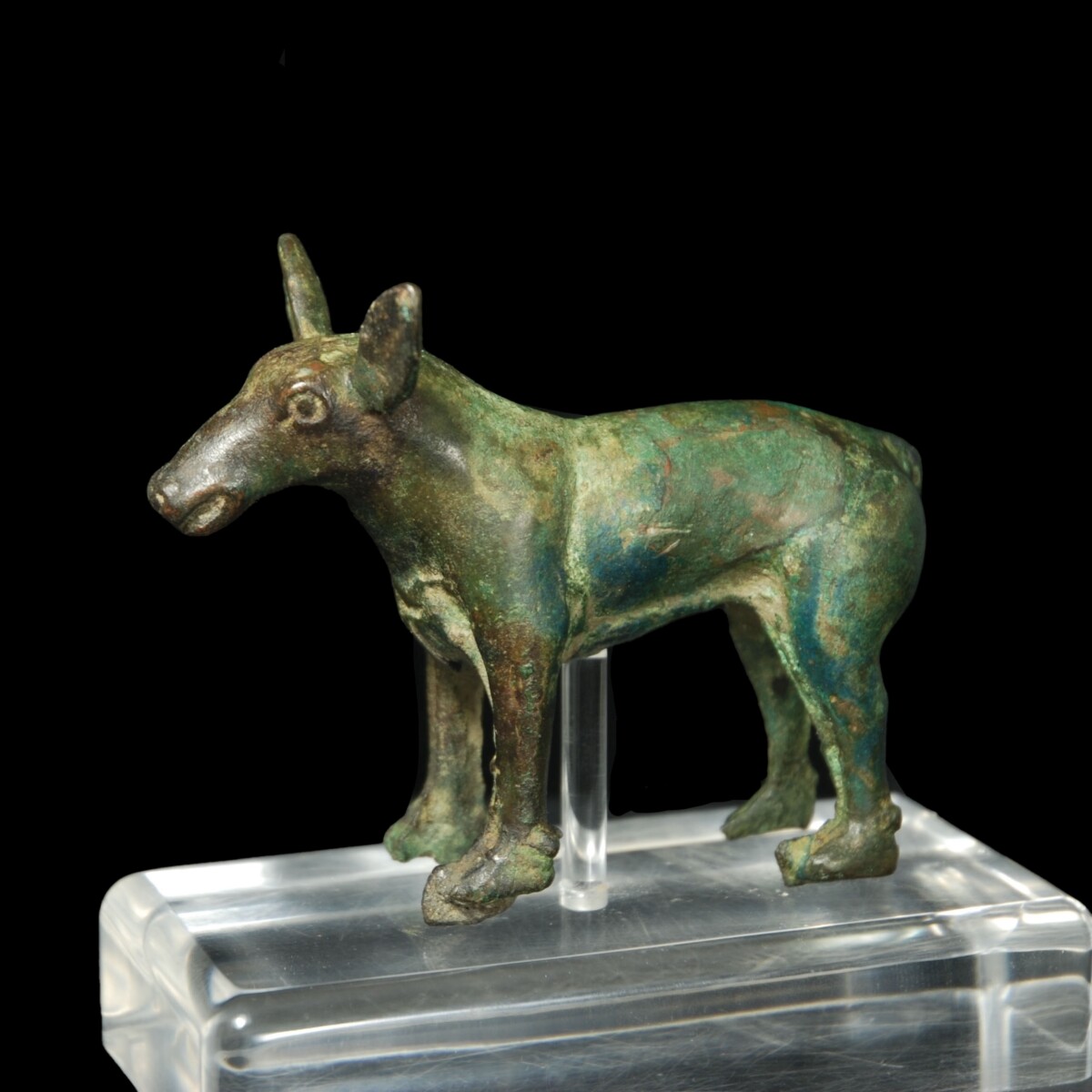
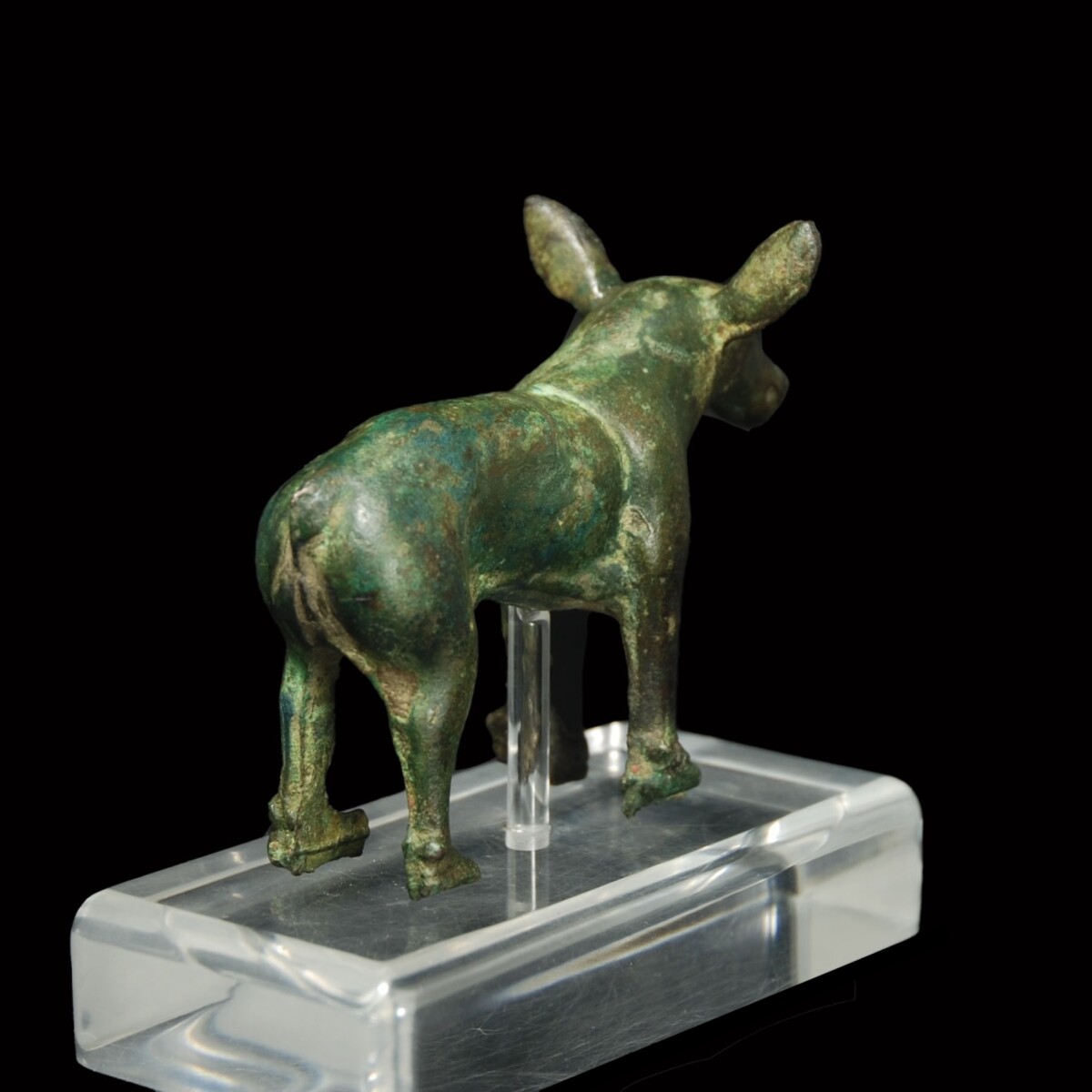
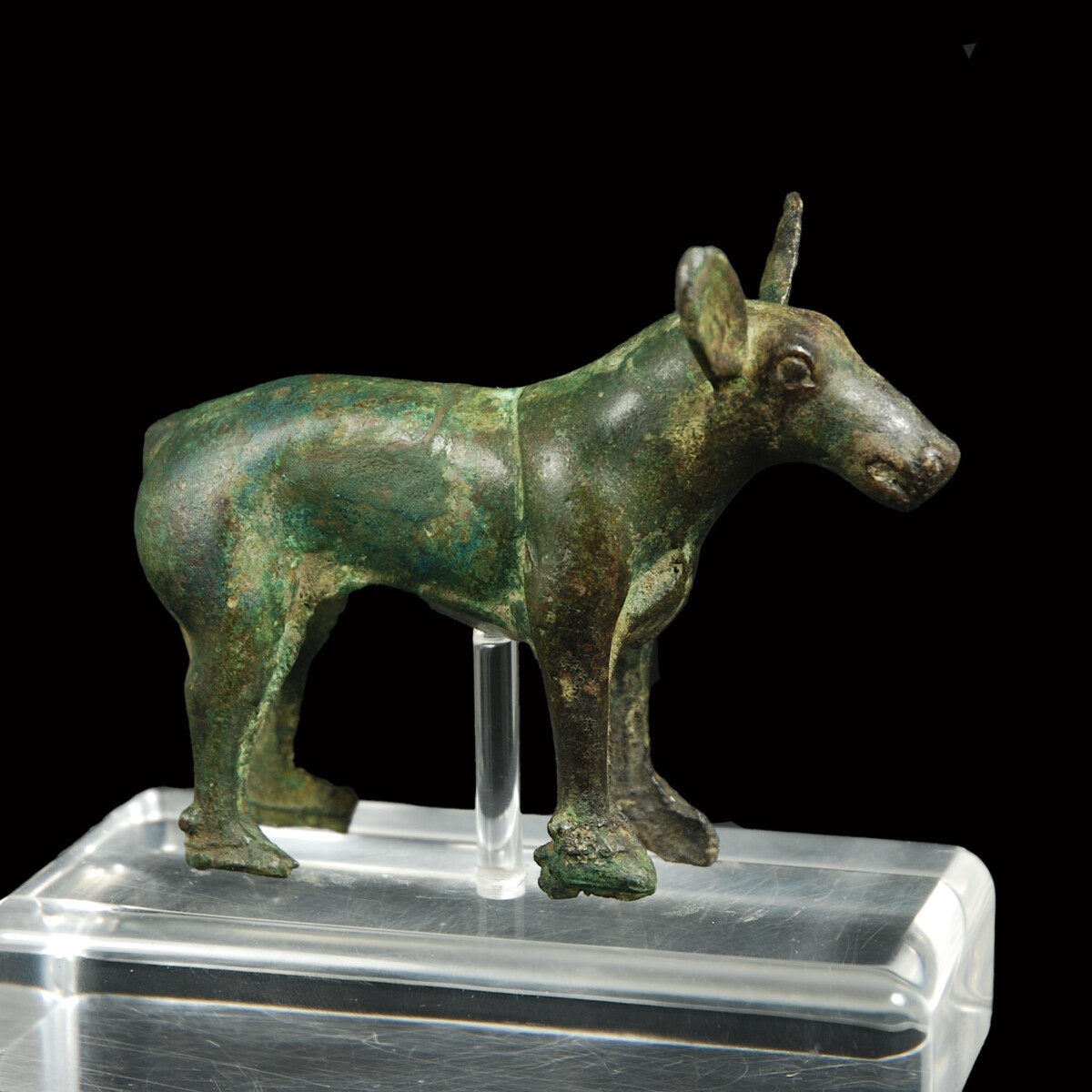
Scythian Bronze Statuette of a Fawn
Culture: Scythian
Period: Late 6th to Early 5th Century B.C.
Material: Bronze
Dimensions: 8.8 cm x 11.2 cm
Price: 3 200 Euro
Ref: 5284
Provenance: From a private American collection in Kīhei, Hawaii. Acquired on October 11, 1998, from I. M. Chait in Beverly Hills, lot 252. With a copy of the invoice.
Condition: Left ear reattached, otherwise intact.
Description: Finely crafted, heavy bronze statuette of a fawn or young moose, originating from the culture of the Scythian steppe peoples. The animal has a slit on its belly and was soldered to an object, probably a cauldron, with its legs, where it served as a zoomorphic handle. The animal is depicted in an alert posture. Its round eyes are wide open, its nostrils at the end of its long snout are flared. The head is raised, and the oversized ears stand upright. This type of stylization is typical of Scythian animal depictions and is intended to emphasize heightened alertness. The massive body, on the other hand, is rendered in a naturalistic style. The musculature of the shoulders and thighs, as well as the proportions of the back and legs, are finely detailed. A small tail protrudes from the rear of the round buttocks. Compare a similar zoomorphic handle (albeit made of gold) from a cauldron from the “kurgan” (burial mound) in Chochlatsch, which is now in the Hermitage in St. Petersburg, with the inventory number 2213/13. Published in: Wilfried Seipel (ed.) "Gold der Steppe. Sensationsfunde aus Fürstengräbern der Skythen und Sarmaten", Leoben 2007, p. 236, no. 90. For a comparison of the depiction of the face and ears, see also the pole attachment in the same publication, p. 128, no. 12. On an acrylic base.