


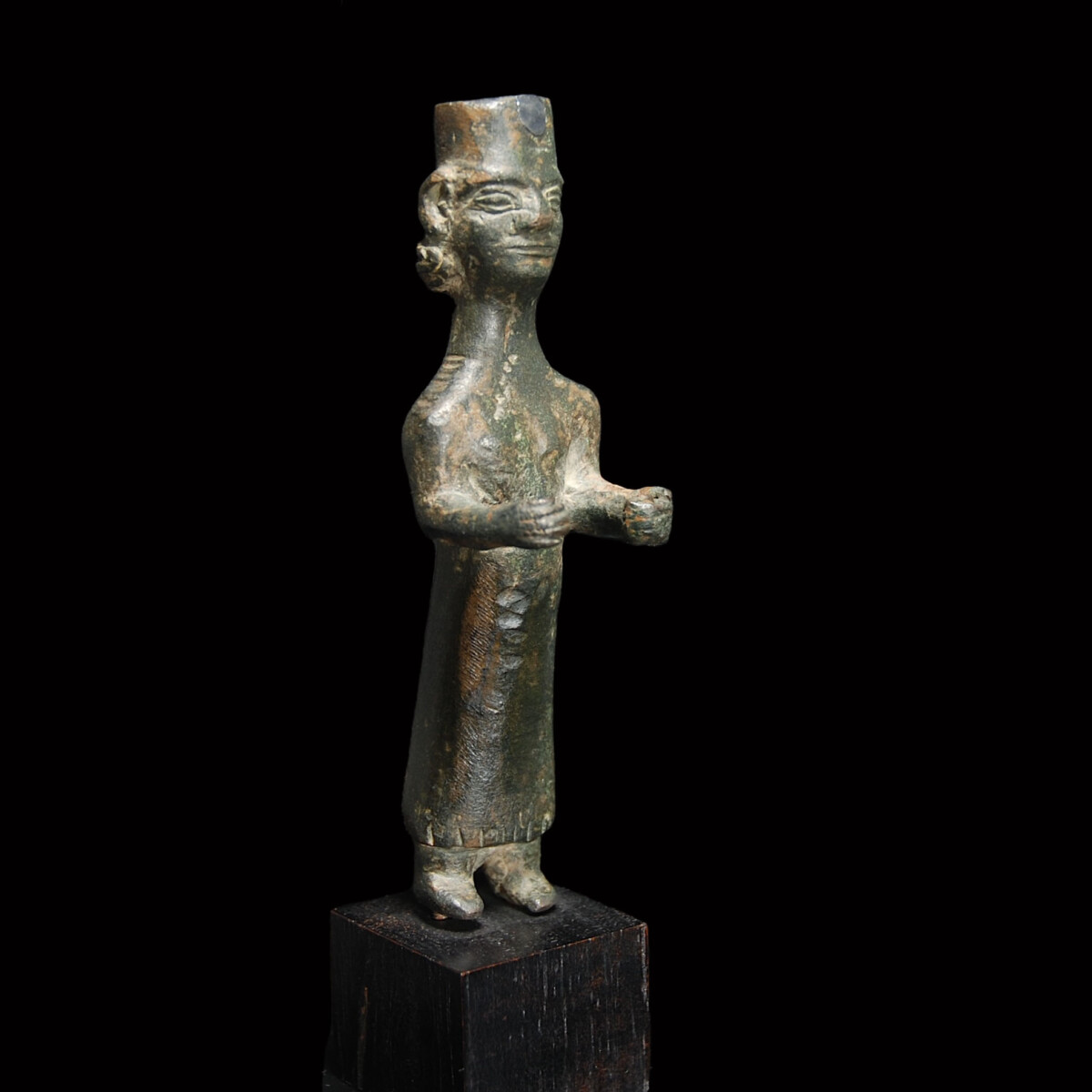
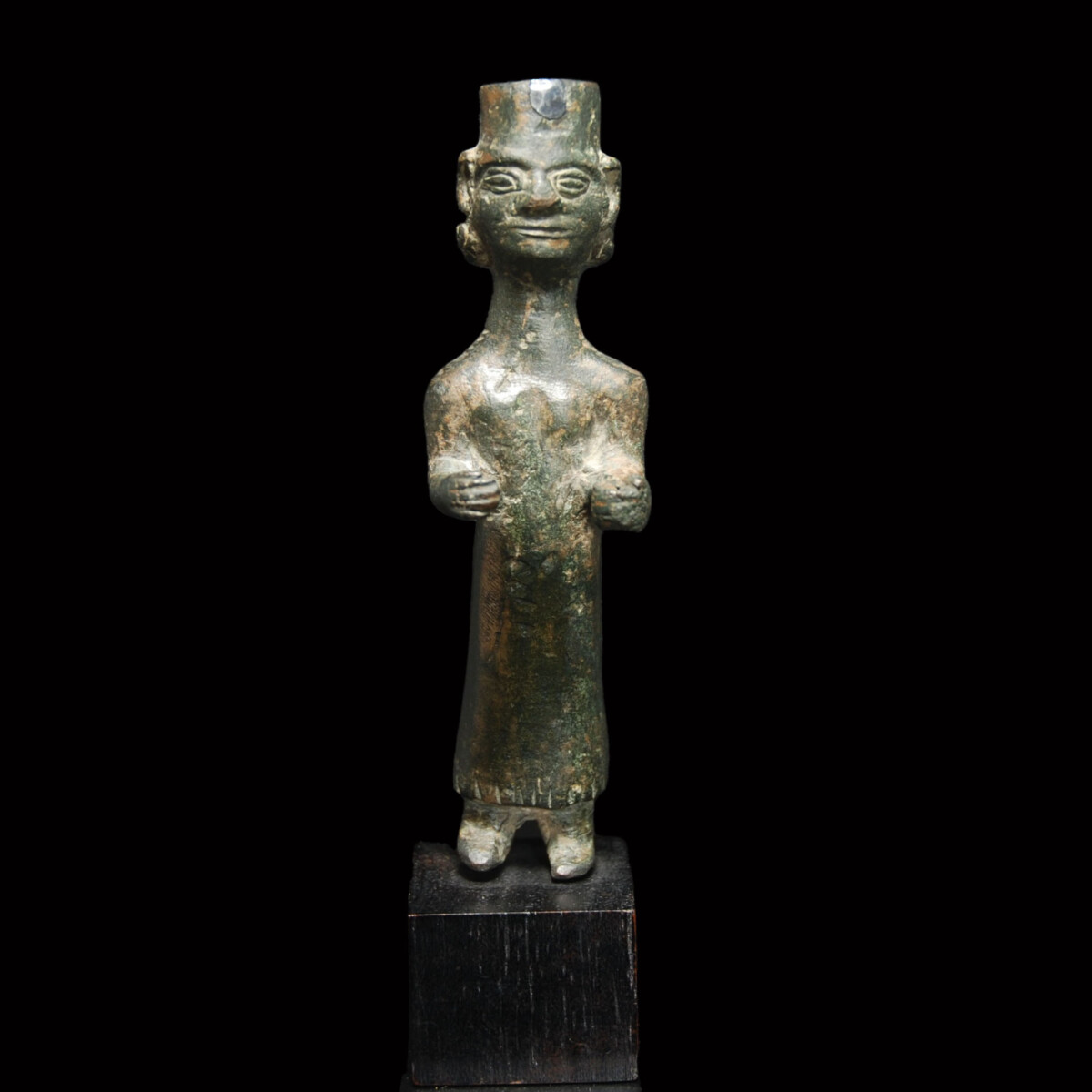
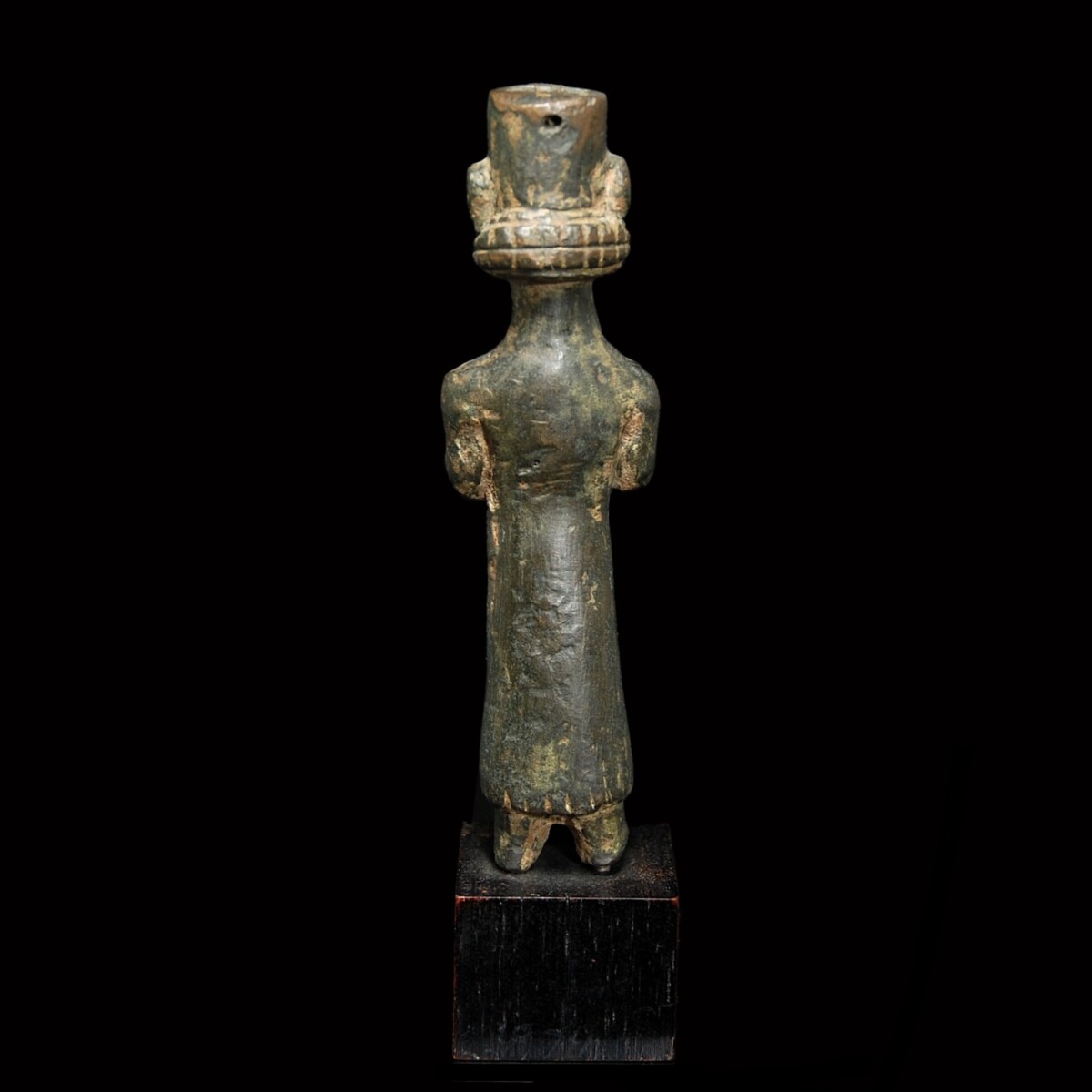
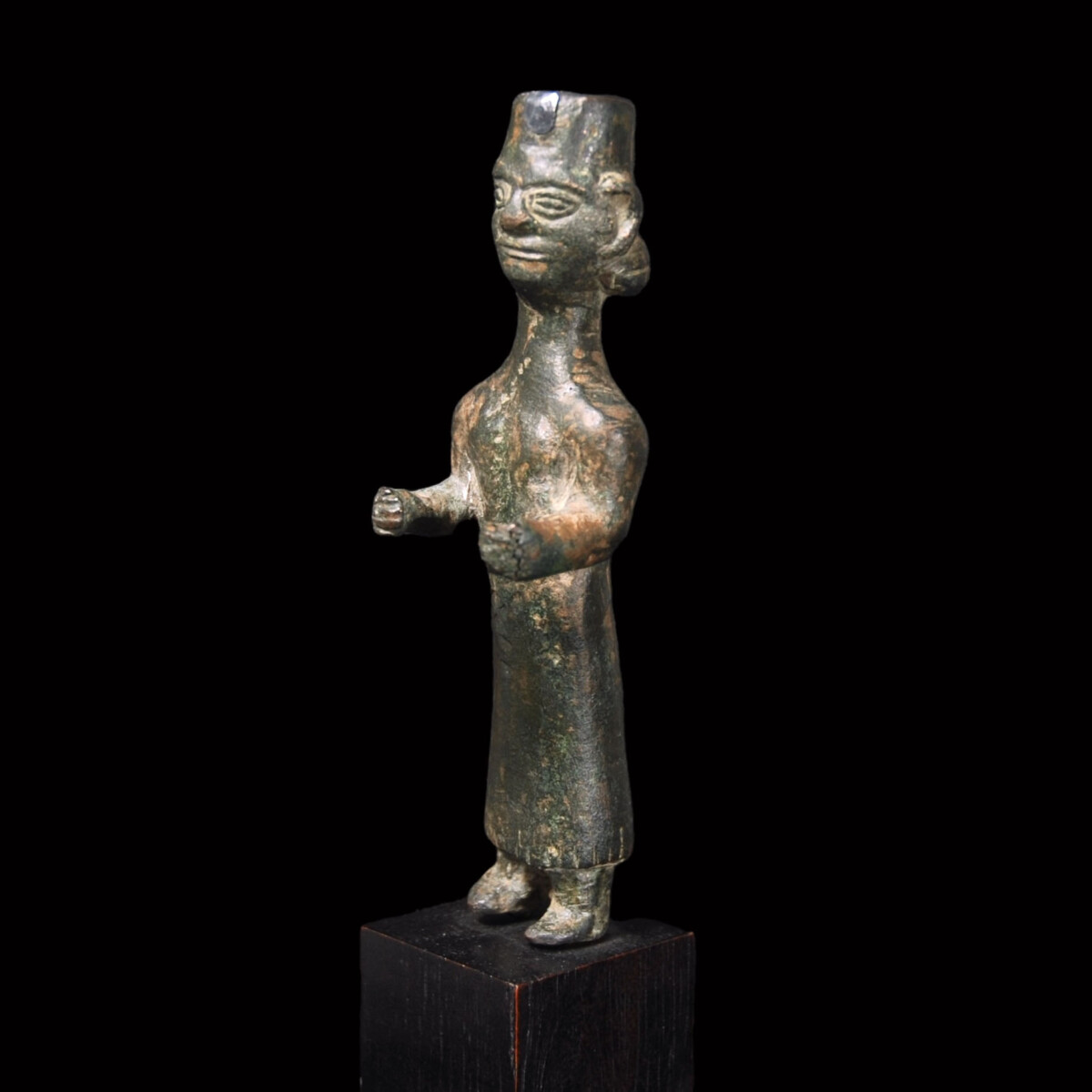
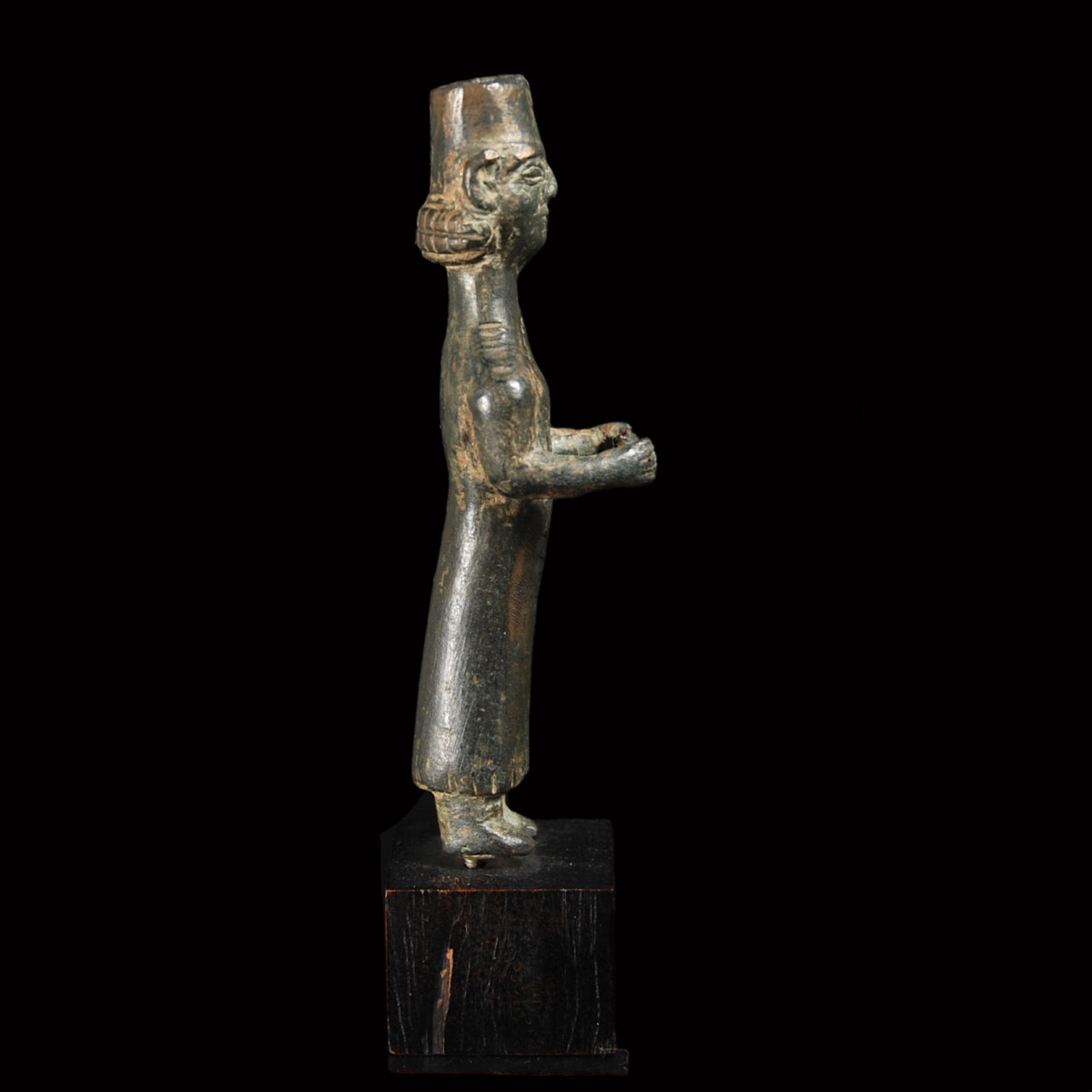
Urartian Bronze Statuette of Priestess
Culture: Urartian
Period: 8th-7th century B.C.
Material: Bronze
Dimensions: 10.3 cm high
Price: 6 800 Euro
Ref: 6662
Provenance: German private collection Dr. Rosemarie Kuhn-Lucht, at least since the 1970s to the early 1980s (with a confirmation). Thence with Antikenkabinett Gackstätter with the list number 03445. There acquired on 6 November 2006 by the Swiss collection Charles and Hedy Indlekofer. With the original certificate by Bernd Gackstätter and the invoice copy of 2006.
Condition: Intact, only with minimal wear. The attributes in the hands and the headdress in the polos were separately worked out and today missing.
Description: Solid bronze statuette of a priestess from the Urartian Kingdom, which rose to great power in the 9th century B.C. in Asia Minor, before it declined after around 300 years and was conquered by the Medes. The woman wears a long gown reaching to the bottom, which slightly swings outwards and ends with fringes. Her small round breasts are clearly accentuated. She wears a cylindrical-shaped polos on the head, where a crown of a different material (ivory?) was inserted. The ornamental object was attached to the polos in the front through a still-preserved pin and rivet, and at the rear through a hole. The head of the priestess sits oversized but sublimely on the long neck. She looks out with almond-shaped eyes between thick lids straight ahead, her broad mouth is formed to a gentle smile. The face is round, the nose broad. The big ears protrude on the sides, pushing back the rows of curls, which look out from the polos. In the nape the hairstyle forms two thick rows of curls. The woman has her arms along the slender upper body stretched out and bent. The hands are in holding position and once held separately worked out and today missing offerings. See for the posture of the statuette in the British Museum with the registration number 1874,1003.1. As well as another woman statuette in: Gisela Zahlhaas “Orient und Okzident. Kulturelle Wurzeln Alteuropas 7000 bis 15 v. Chr. ”, Munich 1995, fig. I. Mounted.