



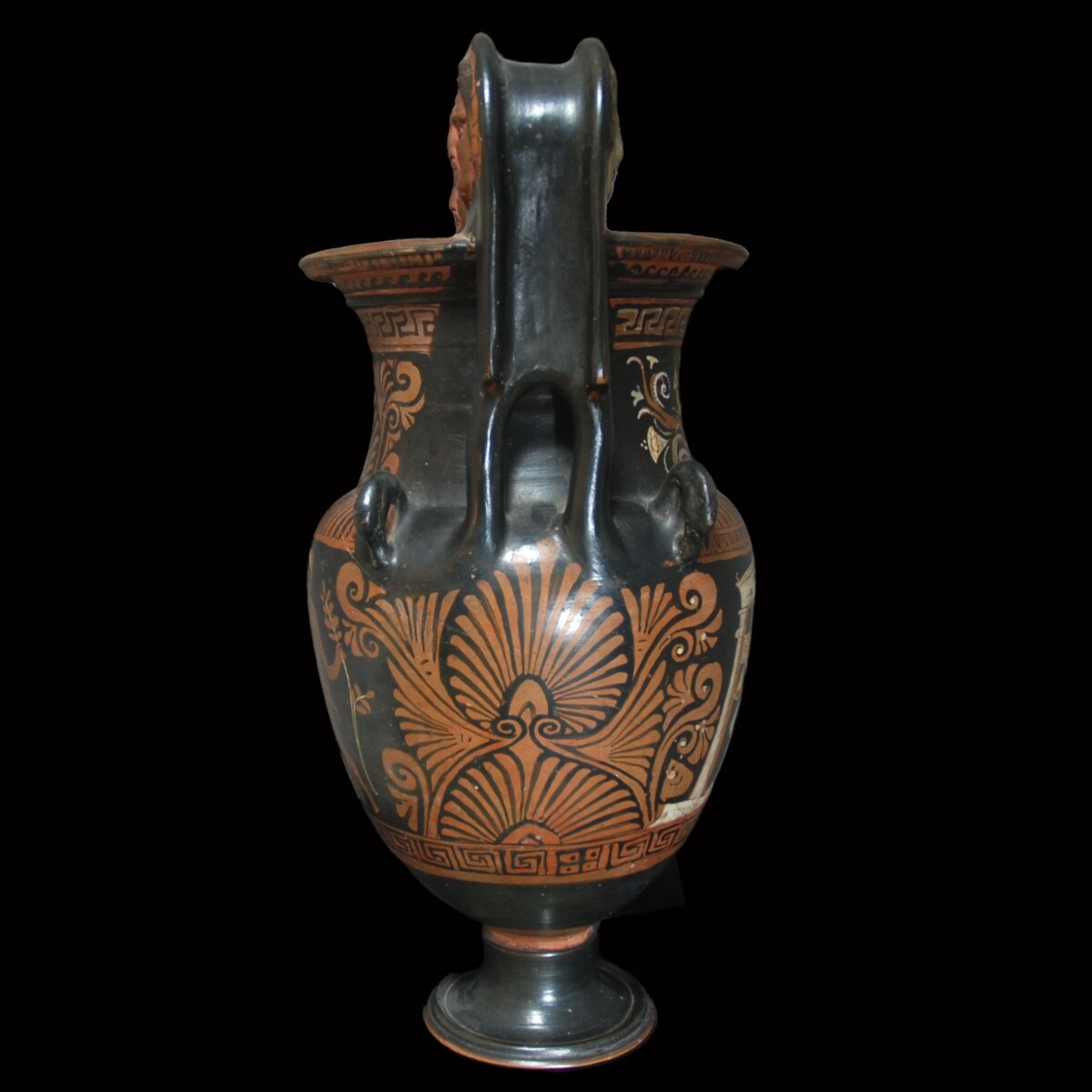

Apulian Volute Krater from the Workshop of the T.C. Group
Culture: Greek/Apulia
Period: Late 4th century B.C.
Material: Terracotta
Dimensions: 52.5 cm high
Price: 16 000 Euro
Ref: 2659
Provenance: In the Austrian private collection of Professor Dr. René Clemencic since at least the mid-1980s. Acquired at that time from the Viennese art trade. Thence Auktionshaus im Kinsky, Vienna, on 17 June 2015, lot 924. Acquired there by the former director of the Austrian National Bank, Dr. Ewald Nowotny. Until recently, in the family estate.
Condition: Professionally reassembled from two pieces without any missing parts. Very minor chips. Otherwise, very well preserved.
Description: Highly decorative Apulian volute krater with red-figure painting and details in white and yellow. The central image on the front shows a naiskos formed by two Ionic columns and a triangular pediment. Within the funerary shrine, a naked warrior with curly blond hair, representing the deceased, sits on a rock facing left. In his right hand, he holds a larnax and a pilos helmet. Above the larnax are several floral wreaths, which refer to his achievements and high status. In his left hand, he holds another wreath extended behind him. His sword hangs over his left shoulder. On the neck of the large vase is the head of a woman in profile to the left, painted in white with details in yellow. She wears a sakkos covering her hair. The portrait is flanked by branches and tendrils with volutes and flowers. Above the scene runs a meander band, followed by a surrounding plastic rib in black, and above it a wave band. The reverse side features, in the central pictorial field, a maenad in a peplos dancing to the left, turning towards a naked satyr who is following her. She holds a cista in her left hand and a headband in her right. Earrings, bracelets, and a necklace are highlighted in white. The satyr wears no jewellery apart from a hairband. In his right hand, he holds the leopard skin of Dionysos, and in his left a branch resembling a thyrsos. On both sides, the pictorial fields are bordered below by a continuous meander band, beneath which begins the finely profiled, widely flaring ring foot. The monumental funerary krater features four plastic swan heads on the shoulder, with a tongue pattern and egg-and-dart motif between them. The powerful, grooved handles rise well above the rim and end in the eponymous volutes, which feature sculpted Gorgon heads on both sides – on the front with white faces and blond, tousled hair, and on the back with clay-colored faces and black hair. The vase originates from the workshop of the so-called T.C. Group, which stands for “ Taranto from Canosa.” The workshop follows the tradition of the Baltimore Painter. Characteristics of the T.C. Group are the faces of the figures, with open mouths above a protruding lower lip and pronounced chins.